Beyond the Expected: The Discreet Amenities That Define What Ultra-Affluent Buyers Actually Require in 2024
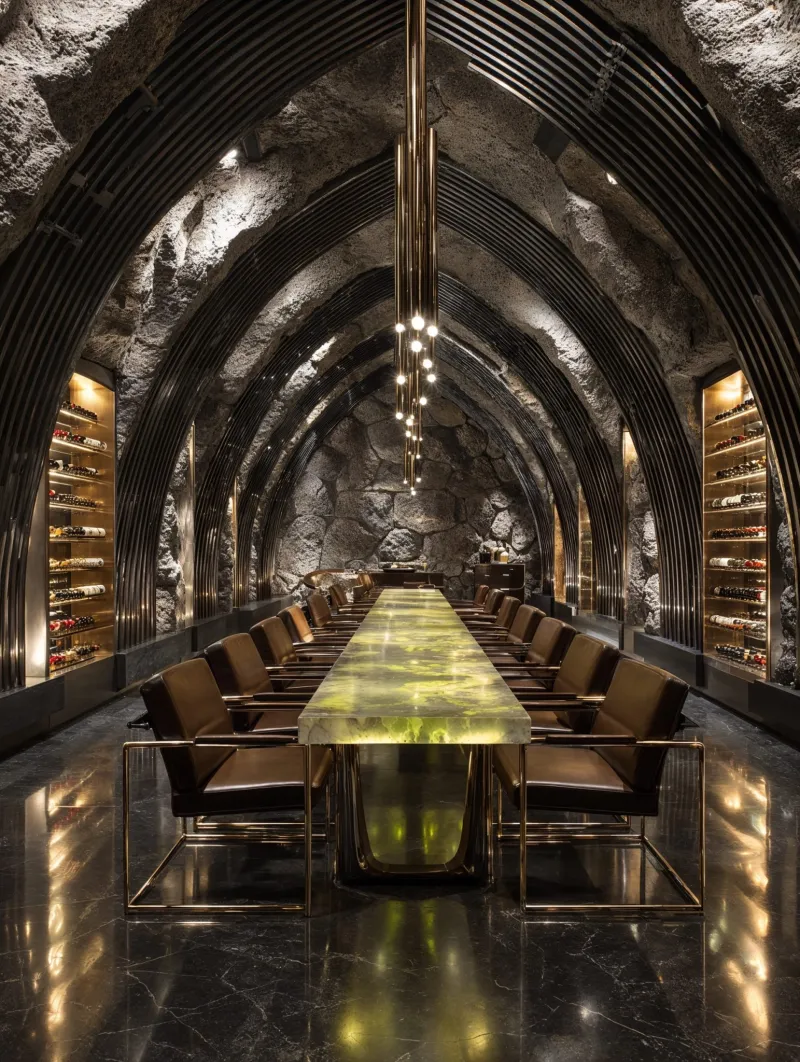
Photo: luxury estate underground wine cellar smart home wellness center, via aidesignlab.net
There exists a persistent misconception in the broader real estate conversation that luxury, at its highest expression, is primarily a matter of size and surface finish. Square footage. Imported stone. Designer appliance packages. These elements, while expected at the premium tier, have effectively become table stakes—the minimum acceptable standard rather than the differentiating factors that motivate serious buyers to act.
The clients who populate the true upper echelon of the American residential market—family offices, C-suite executives, entertainment figures, and multi-generational wealth holders—approach property acquisition with an entirely different calculus. Their requirements are shaped by lived experience at a global scale, informed by advisors across legal, security, and wellness disciplines, and refined by the accumulated wisdom of having owned exceptional properties before.
What follows is Château Chandler's examination of five features that our network of luxury specialists consistently identifies as genuine purchase determinants for this buyer profile in 2024—amenities that rarely appear in headline marketing copy but are quietly decisive in the final analysis.
1. Integrated Security Architecture: The Hardened Estate
In an era of heightened awareness around personal security, the most serious buyers at the uppermost market tier do not treat protective infrastructure as an optional upgrade. They treat it as a foundational requirement—and they assess it with the same rigor they apply to structural engineering.
The modern hardened estate goes considerably further than perimeter cameras and a monitored alarm system. Buyers at this level expect dedicated safe rooms or hardened shelter spaces engineered to current ballistic and forced-entry standards, with independent communication systems, filtered air supply, and sufficient provisions for extended occupancy. They expect perimeter detection technology that distinguishes between environmental triggers and human intrusion. They expect access control systems sophisticated enough to manage household staff, contractors, and visitors through tiered credentialing rather than simple key distribution.
Luxury agents working in markets such as Beverly Park, Fisher Island, and the gated communities of Paradise Valley, Arizona, report that security infrastructure assessments now routinely precede interior walkthroughs for their highest-net-worth clientele. A property that cannot satisfy due diligence at this level will not advance in the consideration set, regardless of its aesthetic merits.
2. The Private Wellness Campus: Health Infrastructure as a Non-Negotiable
The wellness amenity conversation has matured considerably since the era when a home gym and a steam shower represented the pinnacle of residential health infrastructure. Today's ultra-affluent buyer expects a comprehensive wellness ecosystem that can meaningfully reduce—or in some cases eliminate—the need to engage with commercial facilities.
The properties that satisfy this requirement in 2024 typically feature dedicated spaces for multiple wellness modalities under one roof: a fully equipped strength and conditioning facility with professional-grade equipment; a lap pool or endless pool configured for serious athletic training; a sauna suite that may include both traditional Finnish and infrared configurations; a cold plunge or cryotherapy installation; and increasingly, a dedicated space for recovery-focused treatments such as hyperbaric oxygen therapy or IV wellness protocols.
Beyond the physical infrastructure, buyers are now requesting that wellness spaces be architecturally integrated rather than retrofitted—designed from the ground up with appropriate ceiling heights, humidity management systems, specialized flooring, and acoustic separation that allow these spaces to function at a professional standard. A wellness center that feels like an afterthought is, to this buyer, evidence of a broader failure of vision.
3. The Underground Wine and Spirits Cellar: Connoisseurship Meets Climate Science
For a significant segment of ultra-high-net-worth buyers, a serious wine collection is not a hobby. It is an asset class—one that may represent a meaningful portion of overall net worth and that requires the same quality of stewardship as any other significant investment. The residential wine storage solution must reflect this reality.
The benchmark has moved well beyond a temperature-controlled room adjacent to the kitchen. Buyers with serious collections demand underground cellars—purpose-built spaces that leverage the natural thermal stability of below-grade construction—engineered to maintain precise temperature and humidity parameters across all seasons without mechanical strain. These spaces are increasingly designed as full hospitality environments: stone or brick-lined tasting rooms with proper sommelier service infrastructure, custom racking systems designed for both accessibility and display, and digital inventory management integration that connects to estate management software.
In recent transactions across Napa Valley, the North Shore of Chicago, and select New York Hudson Valley estates reviewed by Château Chandler, purpose-built underground cellars with capacity above 3,000 bottles and dedicated tasting room configurations have been cited by buyer representatives as specific acquisition criteria. Properties without this feature in otherwise competitive listings have been passed over in favor of those that satisfy the requirement.
4. Invisible Smart Home Integration: Technology That Serves Rather Than Complicates
The smart home conversation has, for many years, been dominated by a feature-quantity mentality—the assumption that more automation, more touchscreens, and more voice-activated systems translate directly to more value. The most sophisticated buyers in today's market have largely rejected this premise. Their experience with poorly integrated technology in prior properties has produced a clear and consistent preference: they want systems that are comprehensively capable and entirely invisible.
This means whole-estate automation that manages climate, lighting, security, entertainment, and energy systems through a single unified platform—but that does so with an interface intuitive enough to require no instruction and discreet enough to disappear into the architecture. It means mechanical systems that anticipate occupancy patterns rather than requiring manual adjustment. It means network infrastructure robust enough to support a household's full professional and personal digital demands without dead zones, latency issues, or the need for consumer-grade workarounds.
Critically, buyers are also requesting that smart home systems be designed for longevity and serviceability—a significant departure from earlier market cycles when proprietary systems with limited support lifespans were routinely installed in high-value properties. The expectation today is architecture-grade durability: systems that can be updated, expanded, and serviced by multiple qualified vendors rather than locked to a single provider.
5. Curated Outdoor Destination Spaces: The Private Resort Standard
The pandemic era permanently altered the relationship between high-net-worth buyers and their outdoor environments. Properties that previously treated exterior spaces as visual amenities—beautiful to observe from inside the home—are now evaluated on whether they function as self-contained destination environments capable of sustaining extended, high-quality occupation.
This standard encompasses far more than a well-designed pool and terrace. Buyers at this level expect outdoor kitchen and dining infrastructure engineered for serious culinary production, not decorative grilling stations. They expect entertainment environments—covered pavilions, outdoor screening installations, acoustically thoughtful audio systems—that function independently of weather. They expect wellness continuity from interior to exterior: outdoor cold plunge facilities, garden-integrated meditation spaces, and in some cases, fully equipped outdoor fitness environments.
Perhaps most significantly, they expect privacy architecture: landscape design, topography management, and structural screening that creates genuine seclusion rather than the visual suggestion of it. In a world where satellite imagery is freely accessible and drone technology is ubiquitous, the ability of an estate to provide authentic outdoor privacy has become a premium feature that buyers will pay meaningfully to secure.
The common thread connecting all five of these requirements is intentionality. The buyers who define the apex of the American luxury market in 2024 are not impressed by amenities that were added to a property as afterthoughts or competitive responses. They are moved by evidence that an estate was conceived from the outset around the way they actually live—with the same rigor, the same standard of excellence, and the same refusal to accept the merely adequate that characterizes every other dimension of their lives.
At Château Chandler, we believe that understanding this distinction is what separates an exceptional listing from an extraordinary one.