Built to Endure: The New Era of Heirloom Lighting Design in America's Finest Estates
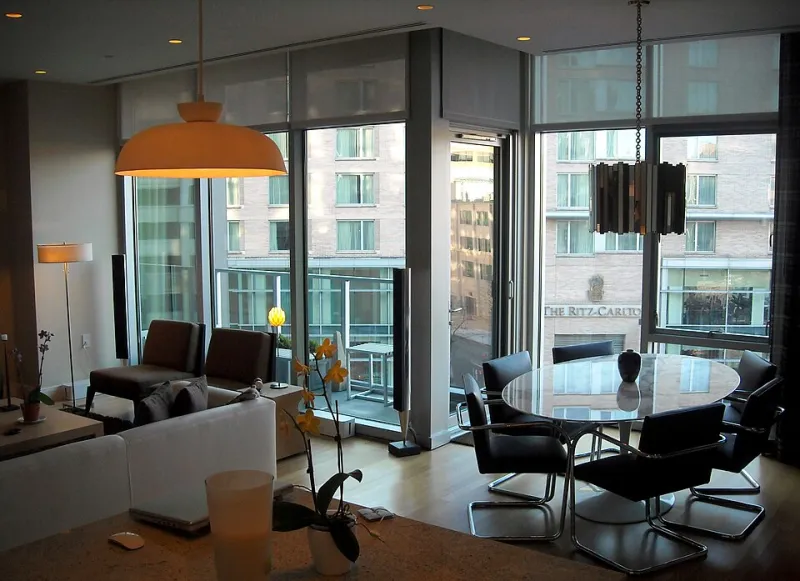
Photo: AgnosticPreachersKid, CC BY-SA 3.0, via Wikimedia Commons
There is a particular quality of light that defines a great estate—one that does not announce itself, yet shapes every room it touches. It falls across stone and silk with equal authority. It ages gracefully alongside the architecture it serves. And, increasingly, it is being designed with a singular ambition that sets it apart from nearly every other element of a luxury home: it is meant to outlast its original owner.
Across the country's most thoughtfully conceived private residences, a quiet but consequential shift is underway. Lighting design—long regarded as a finishing consideration, something addressed after the architecture and interiors have been resolved—is being elevated to an infrastructure priority. Commissioners of these systems are not merely selecting fixtures. They are making decisions that will govern how a home reads and feels for decades, perhaps a century, to come.
From Decoration to Architecture
The distinction matters enormously. Decorative lighting responds to prevailing taste; architectural lighting responds to the building itself. The former changes with ownership. The latter, when executed with genuine foresight, becomes as intrinsic to a property as its ceiling heights or the grain of its limestone floors.
The estates leading this movement tend to share a common characteristic: their owners think in generational terms. They are not furnishing a home for five years of enjoyment before a sale. They are constructing something intended to pass through families, to be inherited rather than liquidated. In that context, lighting infrastructure commands the same long-horizon thinking applied to structural engineering or landscape planning.
Lighting consultants working at this level speak of what they call "legacy commissions"—projects in which the brief explicitly includes adaptability across multiple ownerships, resistance to technological obsolescence, and a visual character so deeply attuned to the architecture that no future resident would wish to replace it wholesale.
The Engineering of Permanence
Achieving that kind of longevity requires a fundamentally different approach to specification. Where a conventional lighting design might rely on proprietary systems tied to a single manufacturer's ecosystem, a legacy installation is built on open protocols and redundant infrastructure—conduit runs positioned for future access, control wiring that accommodates yet-to-exist technologies, and fixture housings engineered for lamp-type evolution as LED and spectral technology continues to advance.
Several estates commissioned in recent years have incorporated what lighting designers describe as a "neutral backbone"—essentially a lighting infrastructure that carries no aesthetic assumptions of its own. Junction points are concealed within ceiling coffers and wall cavities. Power and data pathways are routed with generous tolerances. The visible elements—the fixtures, the trims, the decorative luminaires—can be updated, replaced, or reimagined over time without disturbing the underlying system that serves them.
This is not a modest undertaking. The infrastructure investment in a legacy lighting commission can represent a meaningful portion of a property's overall construction budget, sometimes approaching what a developer would allocate to mechanical systems. For the buyers who pursue it, the expenditure reflects a particular philosophy: that what is hidden within the walls of a great estate is as consequential as what is visible.
Light as the Steward of Architecture
Among the most compelling arguments for treating illumination as a long-term investment is the role it plays in preserving architectural intent. Every serious building has a character—a particular relationship between volume and surface, between solid and void, between the weight of its materials and the openness of its composition. Poor lighting can obscure that character entirely. Thoughtful lighting can sustain it across generations of use and ownership.
Estate owners working with accomplished lighting designers often discover that their homes possess qualities they had not previously perceived. Ceiling planes that appear flat under general illumination reveal subtle modulation when washed at the correct angle. Stone surfaces that read as uniform under cool, overhead light acquire depth and warmth under carefully calibrated grazing sources. These revelations are not incidental—they are the product of a deliberate interpretive process, one in which the lighting designer functions less as a vendor and more as a collaborator in the truest architectural sense.
When that interpretive work is documented carefully—when the angles, intensities, color temperatures, and circuit assignments are recorded with the rigor of an architectural drawing set—it becomes transferable. A future owner, or a future designer working on behalf of that owner, can return to the original intentions and restore or extend them with confidence. The lighting, in this sense, carries institutional memory.
Spectral Intelligence and the Long View
One of the more sophisticated dimensions of legacy lighting design is the deliberate management of spectral quality—the color rendering and color temperature characteristics of each light source throughout the home. These decisions affect not only how spaces feel to their occupants but how art collections are preserved, how textiles and finishes age, and how the home reads across the full arc of a day.
Estates housing significant art collections have long understood the preservation implications of lighting specification. Ultraviolet filtration, tight color rendering indices, and controlled lumen output are standard considerations in gallery and display contexts. What is newer is the application of this thinking throughout a residence—treating every room as an environment where the quality of light has cumulative consequences over years of exposure.
Lighting designers engaged in legacy commissions often work alongside conservation specialists and materials consultants to model how specific light sources will interact with particular finishes, fabrics, and architectural surfaces over time. The resulting specifications are calibrated not only for immediate visual effect but for the preservation of the home's material character across decades of continuous occupation.
The Quiet Dividend
There is, for the buyer considering this level of investment, a practical dimension that sits alongside the philosophical one. Estates with well-documented, architecturally integrated lighting systems command demonstrable advantages at the time of sale. Prospective purchasers at the uppermost tier of the market are increasingly sophisticated about infrastructure quality, and a lighting system that has been designed with longevity, adaptability, and architectural coherence in mind represents a quantifiable asset rather than a sunk cost.
More broadly, a home that has been illuminated with genuine intelligence and foresight simply reads better—in person, in photography, and in the accumulated impression it leaves on everyone who encounters it. That quality is difficult to articulate but impossible to overlook. It is, in the end, what distinguishes an estate that has been finished from one that has been considered.
At Château Chandler, we recognize that the most enduring properties are those in which every system has been approached with the same rigor and ambition brought to their architecture. Lighting, when treated as a legacy discipline rather than a decorative afterthought, becomes one of the most quietly powerful investments a discerning owner can make—not only in the home as it exists today, but in the home as it will be experienced by those who inherit it.