Suspended in Splendor: How the Bespoke Chandelier Has Become the Defining Signature of the American Grand Estate
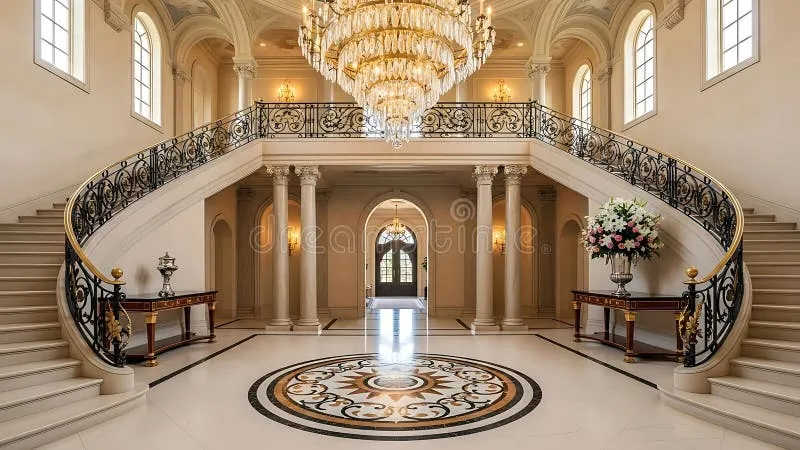
Photo: grand luxury estate foyer with dramatic bespoke crystal chandelier high ceiling, via thumbs.dreamstime.com
There is a moment, known to every architect who has designed for the truly discerning, when a client's gaze drifts upward — past the coffered ceilings, past the gilded moldings — and lingers in the void above a grand foyer or a double-height great room. That pause is not idle. It is, in the parlance of those who commission the finest residential properties in the country, a reckoning with possibility. What fills that space will, in many respects, define everything below it.
For a growing cohort of ultra-wealthy homeowners, the answer to that reckoning is neither a recessed fixture nor a catalog pendant. It is something far more considered: a one-of-a-kind chandelier, conceived in collaboration with world-class artisans, fabricated across months or years, and installed as the singular architectural statement that gives an entire estate its identity.
From Afterthought to Authorship
For much of the twentieth century, even the most lavishly appointed American homes treated lighting as a finishing detail — something selected from a showroom after the walls were painted and the furniture arranged. The chandelier, if present at all, was chosen to complement rather than to lead. That era, among the most sophisticated segment of the market, has decisively ended.
Today's estate-level commissions frequently begin with the chandelier. Interior designers and architects at the highest tier of practice describe clients who arrive not with floor plans, but with images clipped from museum catalogs, photographs taken in Venetian palazzi, or sketches drawn from memory after encountering a particular installation abroad. The fixture is not chosen to suit the room; the room, in many cases, is proportioned to honor the fixture.
This inversion of the traditional design sequence speaks to something profound about how the most discerning buyers now understand their homes. An estate, at this level, is understood as a curated environment — a three-dimensional expression of aesthetic philosophy, cultural literacy, and personal history. The chandelier, suspended at the visual apex of the most significant spaces, is where that philosophy is most boldly declared.
The Anatomy of a Commission
Commissioning a truly bespoke chandelier at the estate level is a process that bears little resemblance to selecting from a luxury showroom. It begins, typically, with an extended dialogue between the homeowner, the interior architect, and a specialist studio — often located in Murano, in the Czech Republic's Bohemian glass country, in metropolitan ateliers across New York or Los Angeles, or among a newer generation of American metalwork studios whose work has begun commanding international attention.
From that dialogue emerges not a product specification, but a narrative brief. What stories does this home tell? What materials speak to the family's heritage or aspirations? Is the estate rooted in the agrarian landscape of the American South, in the coastal restraint of the Pacific Northwest, or in the cosmopolitan energy of a Northeastern urban compound? The answers shape every dimension of the commission: the materials selected, the scale proposed, the quality and temperature of light cast, and the silhouette that will greet residents and guests for generations.
Fabrication at this level routinely spans twelve to thirty-six months. Hand-blown glass elements may be sourced from a single Murano maestro whose waiting list extends years into the future. Structural armatures are engineered to exacting tolerances, accounting for the precise ceiling heights, load-bearing capacities, and seismic or wind considerations particular to each property. Finishing processes — gilding, patination, the application of rock crystal or semi-precious stone — are conducted by specialists whose craft descends through centuries of European and American decorative arts tradition.
The result is, without exception, irreplaceable. No two commissions are alike. No subsequent owner could replicate the piece without beginning the entire process anew.
Presence, Scale, and the Architecture of Awe
What distinguishes a truly exceptional bespoke chandelier from even the finest production fixture is not merely the quality of its materials. It is the quality of its presence — a term that designers use with precision to describe the way a great work commands a space without overwhelming it, draws the eye without demanding it, and transforms the human experience of a room simply by existing within it.
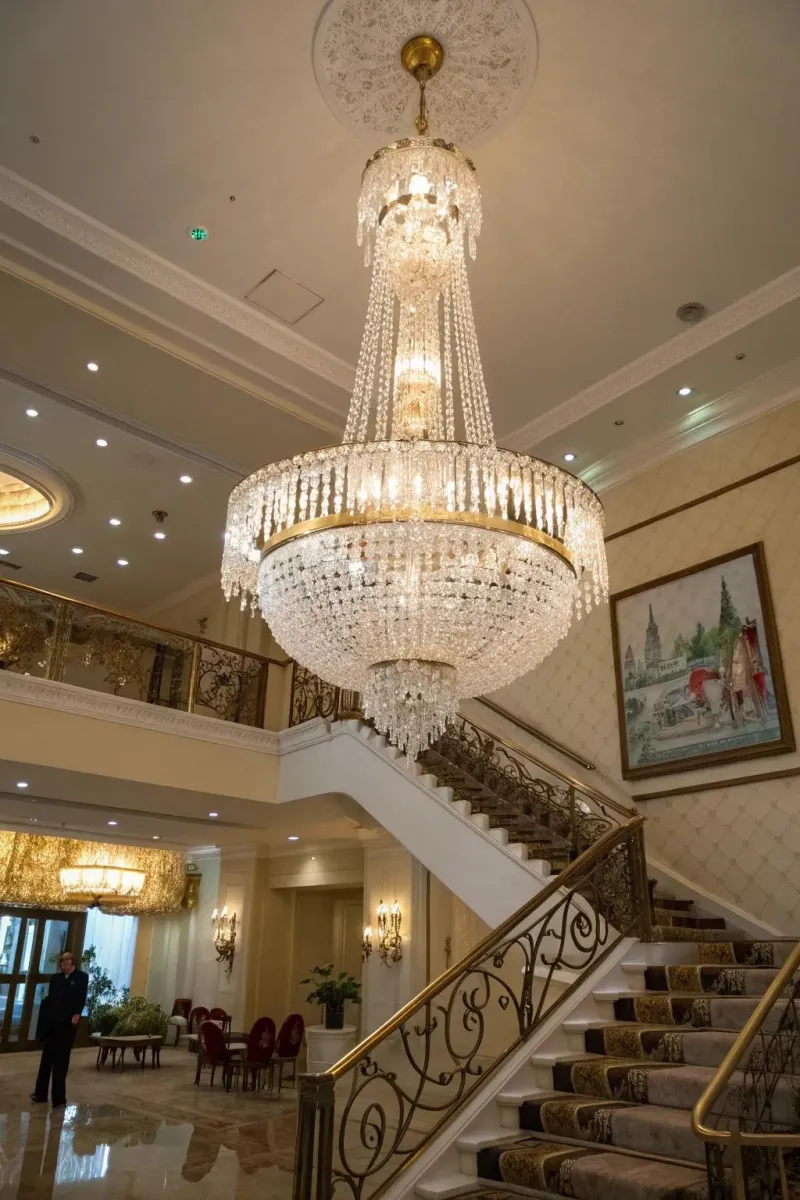
Presence at this scale is an architectural achievement. A chandelier intended for a forty-foot foyer in a Bel Air estate must be scaled not only to the volume of that space but to the proportions of the human figure moving through it. It must read as magnificent from the base of the staircase and intimate from the landing above. It must cast light that flatters the materials surrounding it — the Calacatta marble of the floor, the hand-plastered walls, the bronze hardware of the entry doors — while simultaneously creating its own field of luminous drama after dark.
The most celebrated installations achieve something rarer still: they change. As natural light shifts through the day, as seasons alter the quality of sunlight entering through skylights or clerestory windows, the chandelier responds. Crystal refracts differently at noon than at dusk. Gilded surfaces absorb morning light and release it transformed. The fixture becomes, in this sense, a living element of the estate — one whose character deepens with time and observation.
A Legacy That Outlasts the Transaction
Perhaps the most compelling argument for the bespoke chandelier as an estate's defining signature is the one that extends beyond the current owner's tenure. Unlike furniture, which travels with families, or art, which may be deaccessioned, a chandelier commissioned for a specific architectural context is, in the most meaningful sense, married to its home.
This permanence is increasingly recognized by estate valuators and luxury real estate professionals alike. A documented, provenance-rich bespoke installation — particularly one executed by a studio or maestro of recognized stature — contributes measurably to an estate's perceived value and its narrative appeal to prospective buyers of equivalent sophistication. It signals, without a word of explanation, that the home was built not to a budget but to a vision.
For the families who commission these works, the calculus is simpler and more personal. A chandelier that was conceived in collaboration, fabricated by hand, and installed with ceremony becomes part of the home's story — and, by extension, the family's. Children grow up knowing its name, its origin, the artisan who shaped its glass or forged its armature. Grandchildren inherit not merely a fixture but a narrative thread connecting them to a moment of creative ambition.
The Light That Defines the House
At Château Chandler, we have long held that the finest estates are not assembled from components but authored from convictions. The bespoke chandelier represents that conviction in its most luminous form: a decision to invest not in the expected, but in the singular; not in the decorative, but in the enduring.
For buyers and builders operating at this level of intention, the question is no longer whether a home deserves such a commission. It is whether the vision is bold enough, the dialogue deep enough, and the patience sufficient to see it through. When it is, the result does not merely illuminate a room. It defines one.