Beyond the Gallery Wall: How Today's Most Ambitious Estates Are Built Around Private Collections

Photo: Jbyrne123, CC BY-SA 4.0, via Wikimedia Commons
There is a particular kind of buyer who arrives at a real estate consultation not with a list of bedroom counts and square footage requirements, but with a collection inventory. Perhaps it is two hundred works of postwar American painting. Perhaps it is a cellar of twelve thousand bottles spanning six decades of Burgundy. Perhaps it is a library of first editions assembled over a lifetime of deliberate acquisition. Whatever form the collection takes, the question these buyers bring to their architects and designers is the same: how do we build a home worthy of what we have gathered?
It is a question that is reshaping the upper tier of American residential architecture with quiet but unmistakable force.
A New Kind of Commission
The integration of museum-quality spaces into private residences is not, strictly speaking, a new phenomenon. The great Gilded Age estates of Newport and Long Island were built in part as vessels for European art and antiquities, their galleries and halls designed to rival the collections of Old World aristocracy. What distinguishes the contemporary collector's estate from those earlier precedents is a matter of both intent and precision.
Today's serious collector is not merely seeking a grand room in which to display acquisitions. He or she is commissioning spaces governed by the same environmental and curatorial standards applied by the Metropolitan Museum of Art or the Getty Center — spaces where light levels, humidity, temperature, and air quality are controlled with institutional rigor, and where the architecture itself is conceived as a frame for the objects it contains.
Architects working at this level describe a fundamental shift in the design conversation. The collection is no longer accommodated by the residence; in the most ambitious projects, the residence is organized around the collection.
The Gallery as Living Space
One of the central challenges in designing a private gallery for residential use is the tension between institutional standards and domestic warmth. A museum gallery optimized for conservation is not, by its nature, a comfortable room. The lighting is controlled, the surfaces are hard, the atmosphere is cool and still. Translated directly into a home, such a space would feel more like a storage facility than a sanctuary.
The most successful residential galleries resolve this tension through what might be described as calibrated domesticity — spaces that meet archival environmental standards while retaining the scale, material warmth, and spatial generosity of a great private room. Natural light, where it is introduced at all, is filtered through UV-protective glazing and diffused by deep reveals or light shelves. Artificial lighting systems are tuned to render color accurately while remaining adjustable for the rhythms of daily life. Flooring materials — wide-plank oak, honed limestone, poured concrete — are chosen as much for their acoustic properties as their appearance.
The result is a gallery that functions equally well as a setting for a private dinner, a morning of quiet contemplation, or a formal exhibition for invited guests.
The Wine Cellar Reimagined
Few elements of the collector's estate have undergone a more dramatic evolution in recent years than the wine cellar. What was once a utilitarian space — stone walls, wooden racks, a single temperature zone — has become, in the hands of specialists, a work of architecture in its own right.
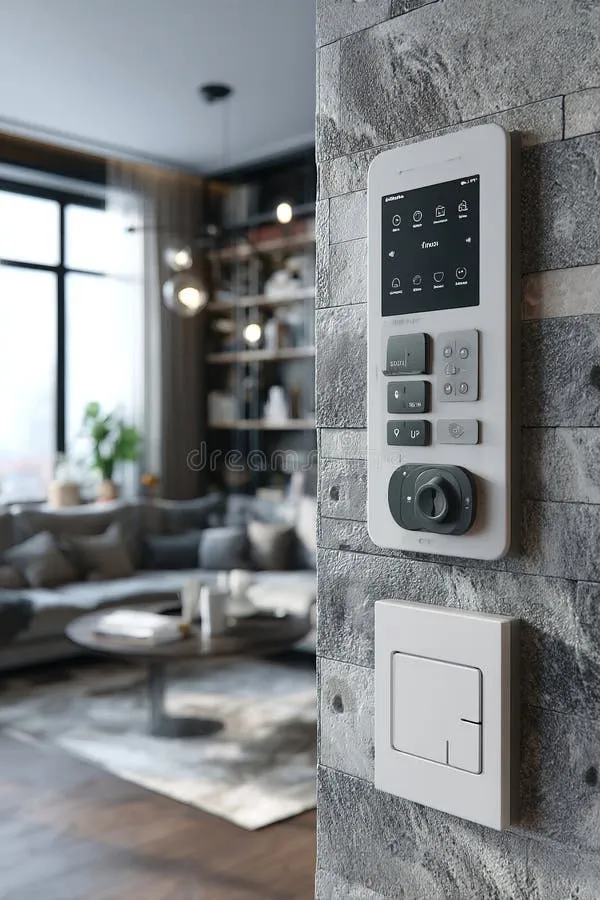
Contemporary archival cellars on the finest American estates now incorporate multiple climate zones calibrated to the precise storage requirements of different varietals and vintages. Humidity is managed independently of temperature. Vibration isolation systems protect fragile older bottles from the ambient movement of the house. Digital inventory systems, often integrated with the estate's broader home automation platform, allow the owner to locate, track, and manage holdings with the precision of a commercial operation.
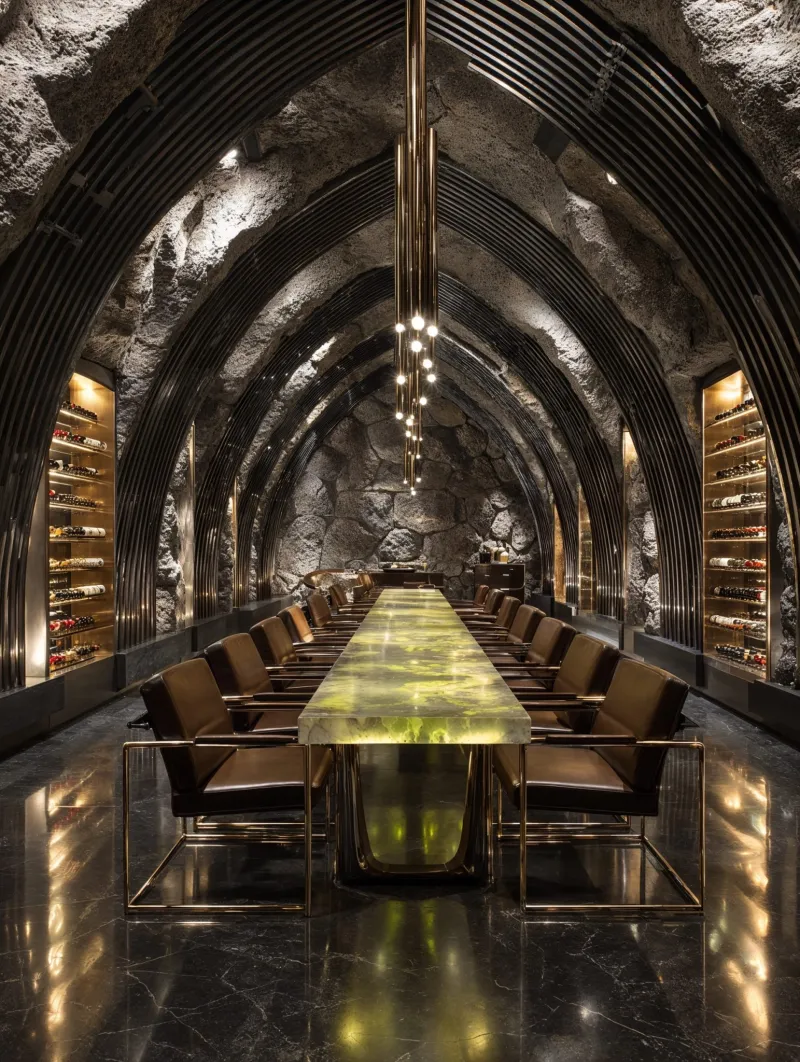
Beyond function, the aesthetic ambition of the modern private cellar has expanded considerably. Spaces clad in reclaimed French oak, illuminated by bespoke iron lanterns, and anchored by a tasting table of considerable presence are now common features in estates marketed at the highest price points. In several notable recent projects in Napa, Aspen, and the Hamptons, the cellar has been positioned as a destination space — a room that guests are deliberately guided through as part of the experience of arriving at the estate.
Rare Book Rooms and Archival Libraries
For a subset of collectors whose passions run toward the bibliographic, the private library has assumed a new level of architectural seriousness. The rare book room of a contemporary American estate bears little resemblance to the paneled study of popular imagination. It is, instead, a precisely engineered environment in which light, humidity, and air filtration are managed to standards that would satisfy a university archive.
Beyond preservation, these rooms are designed to function as genuine working spaces — places where a collector might spend hours with a manuscript, a dealer, or a scholar, surrounded by objects of extraordinary rarity in a setting of corresponding quality. Custom millwork, often designed in close collaboration with a conservator, accommodates volumes of varying dimensions while allowing for the easy retrieval and examination of individual items. Reading tables are positioned to take advantage of controlled natural light. Atmospheric conditions are monitored continuously by building management systems.
The Investment Dimension
For buyers approaching these decisions from a financial perspective, the calculus is increasingly compelling. Museum-quality collection spaces — when properly designed and documented — have been shown to contribute meaningfully to the appraised value of an estate. A property that offers not merely square footage but a fully realized institutional infrastructure for serious collecting represents a category of its own in the luxury market, one for which comparables are scarce and premium pricing is well supported.
More broadly, the integration of a distinguished collection into an estate's architecture transforms the property into something that transcends the conventional definition of real estate. It becomes, in the fullest sense, a legacy — a place built not only for the comfort of its owner but for the preservation and celebration of what that owner has spent a lifetime assembling.
For the collector who has always believed that the objects one loves deserve the finest possible home, the collector's estate is not an indulgence. It is, quite simply, the logical conclusion.