The 2025 Wishlist Decoded: Ten Amenities America's Estate Buyers Refuse to Live Without
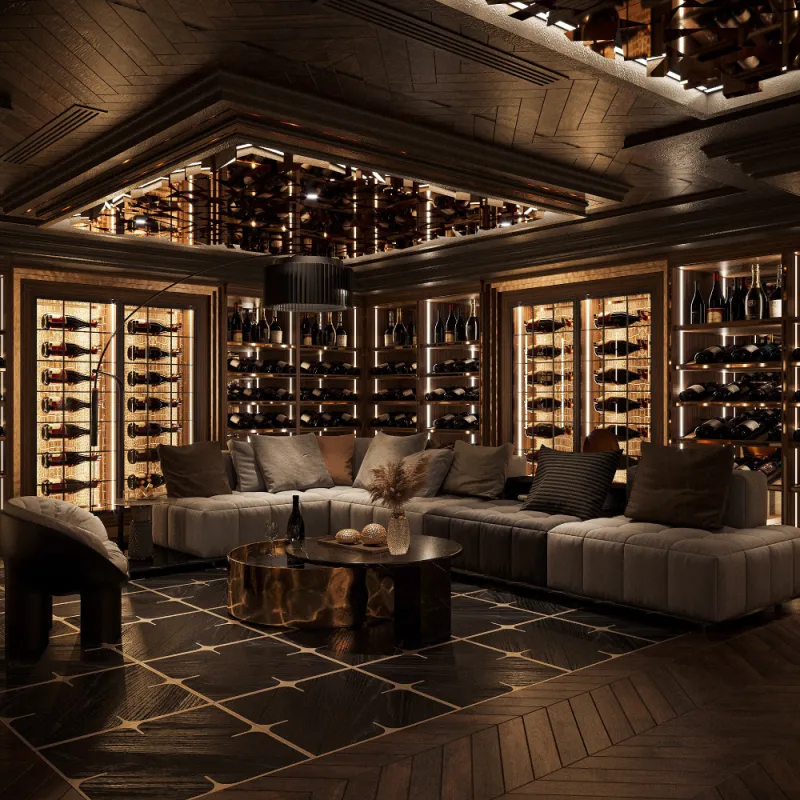
Photo: luxury home wine cellar tasting room modern estate interior, via i.pinimg.com
Ask a dozen luxury brokers what buyers want in 2025 and you will hear the same list, in roughly the same order, from Palm Beach to Park City. That consensus is unusual — luxury demand is typically fragmented — and it makes this a useful moment to codify the canon. Below, ranked by how often brokers describe a feature as deal-critical rather than merely desirable, is the 2025 wishlist, with realistic cost ranges for those planning a build or renovation.
1. The Wine Program, Not the Wine Cellar
The passive cellar is dead; what buyers want now is a complete program — a glass-enclosed tower or display wall, a separate tasting salon with proper acoustics, and capacity in the 2,000-to-5,000-bottle range. Cost: $150,000 to $1.5 million depending on ambition. In Texas and California new construction, it is the single most commonly specified luxury feature.
2. The Wellness Wing
No longer a gym with a treadmill, the modern wellness suite integrates a strength studio, cold plunge, sauna or steam room, and often a dedicated treatment room for visiting practitioners. Cost: $400,000 to $2 million. Buyers increasingly ask whether the space can accommodate a resident massage therapist — a staffing question as much as a design one.
3. The Sport Court in Disguise
Basketball and pickleball remain the dominant requests, but the design brief has changed: the court must disappear into the architecture. Barn-clad structures, sunken pits below grade, and acoustic wrapping so neighbors hear nothing are now standard. Cost: $250,000 to $1 million with the building envelope.
4. The Secondary Kitchen and Catering Infrastructure
Formal dining rooms have returned, and with them the demand for back-of-house capacity — a second kitchen for staff, separate dish and prep zones, and service corridors that keep caterers invisible during an event.
5. The Office That Is Actually Private
Post-2020, the home office graduated from a desk in a corner to a fully acoustically sealed suite with independent climate control and, ideally, a separate entrance for meetings. Cost: modest by estate standards, but its absence kills more deals than brokers admit.
6. The Vehicle Gallery
Not a garage — a gallery. Turntables, vehicle lifts, and lounge seating that frames the collection as exhibition. Climate control is non-negotiable for the collector market.
7. The Bunker, Rebranded
Safe rooms and hardened spaces remain firmly on the list, though brokers report buyers now prefer the language of "resilience suites" — spaces that double as media rooms or wine storage so the security function is never visible.
8. The Guest Compound
The single guest suite has given way to detached guest houses with full kitchens, reflecting the rise of the multigenerational estate and the extended-stay visitor. In markets like Scottsdale and Naples, a guest structure is close to a default expectation.
9. The Equestrian or Agri-Lite Feature
Even buyers without horses increasingly want a small, beautifully executed stable, orchard, or garden complex — a nod to the agrarian estate aesthetic that has swept the market.
10. The Water Feature With a Purpose
Pools persist, but the request has matured into lap-and-contrast configurations — cold plunge paired with a heated pool, often integrated into the wellness wing rather than the landscape.
What Is Quietly Falling From Favor
Just as instructive is what is disappearing. The basement home theater, once universal, is fading — replaced by screening rooms integrated into main-level living or, more often, by high-performance media in the family room. The single-purpose bowling alley and the Las Vegas-style game room have similarly cooled; buyers now prefer flexible recreation spaces that age well. And the infinity pool, once the definitive statement, has become so expected that it no longer differentiates anything at all.
The Underlying Pattern
Read the list as a whole and a philosophy emerges: today's buyer wants amenities that support routines, not performances. The wine program serves a weekly ritual; the wellness wing serves a daily one. Even the vehicle gallery is, at heart, about a passion practiced regularly.
For sellers, the implication is clear — stage and describe your amenities in terms of use, not spectacle. For buyers, it is a reminder that the checklist is not vanity. It is a portrait of the life you intend to live, itemized.