The Silent Persuader: How Chandelier Design Shapes Buyer Decisions in America's Ultra-Luxury Estate Market
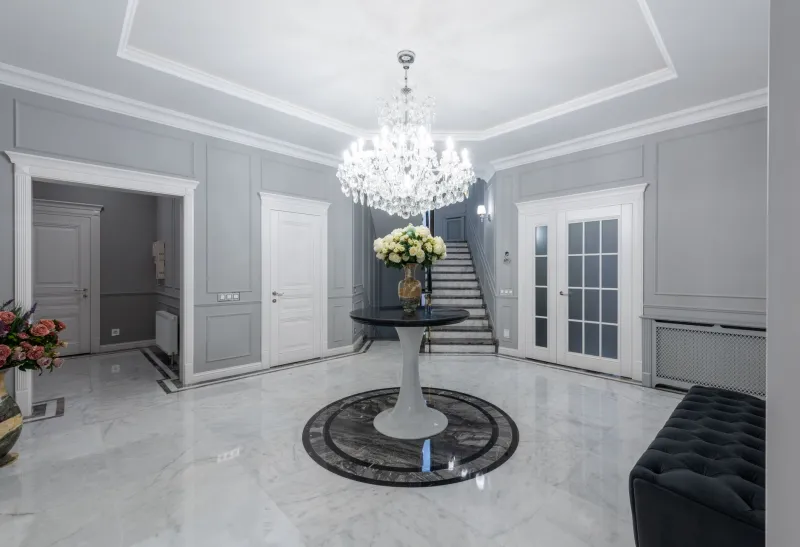
There is a moment — familiar to every seasoned luxury broker — that occurs within the first minutes of a property showing. A prospective buyer steps across the threshold, lifts their gaze, and goes momentarily still. The conversation pauses. The clipboard lowers. Something has registered that no floor plan, no listing photograph, and no carefully prepared narrative could have fully anticipated. In the overwhelming majority of cases, what arrested that buyer's attention was suspended above their head.
The chandelier, long regarded as a decorative flourish, has quietly assumed a far more consequential role in the architecture of the ultra-luxury transaction. It is, in the estimation of many of the country's most accomplished estate brokers and lighting designers, nothing less than a psychological instrument — one capable of compressing weeks of deliberation into a single, visceral impression.
The Neuroscience of the First Glance
The human eye is drawn instinctively upward upon entering an unfamiliar space. Evolutionary psychologists attribute this to threat-assessment behavior — an ancient reflex that luxury designers have, perhaps unknowingly, been exploiting for centuries. When that upward glance is rewarded with a composition of light, form, and material that communicates mastery, the brain releases a cascade of responses associated with safety, status, and belonging.
Lighting architects who work at the highest levels of residential design have long understood this mechanism intuitively. What has changed in recent years is the degree to which that understanding is being applied with deliberate, transactional intent. The bespoke chandelier is no longer simply commissioned to complement an interior; it is increasingly conceived as a strategic asset within the sales process itself.
Luxury brokers operating in markets such as Greenwich, Palm Beach, Bel Air, and the Hamptons report that properties anchored by a singular, commanding fixture consistently command stronger opening offers and shorter negotiation cycles. The fixture functions, in effect, as a pre-emptive argument — one that communicates the estate's value in a language that bypasses rational analysis entirely.
When the Broker and the Designer Share a Strategy
The collaboration between high-end real estate professionals and bespoke lighting ateliers is not yet universal, but it is growing with notable momentum. Forward-thinking brokers have begun engaging lighting consultants during the pre-listing phase, treating fixture selection with the same strategic rigor historically reserved for staging furniture or exterior landscaping.
The calculus is straightforward: in a transaction where the asking price reaches eight or nine figures, a chandelier commission in the range of two hundred thousand to half a million dollars represents a modest investment if it meaningfully accelerates the sale or elevates the perceived value of the property. Several brokers working in the country's most competitive luxury corridors have reported that a single fixture, properly conceived and positioned, contributed to offer premiums that dwarfed its cost by an order of magnitude.
The conversation between broker and designer, in these instances, tends to center on a specific question: what emotional state does this property need to produce in a prospective buyer, and what luminous composition will reliably create it? The answer varies considerably depending on the architecture, the target buyer profile, and the nature of the estate itself.
Fixtures That Function as Emotional Anchors
In estate sales psychology, the concept of the emotional anchor is well established. Buyers who form a strong, positive emotional association with a specific element of a property — a view, a material, a spatial sequence — tend to return to that association repeatedly during the deliberation process. It becomes the experiential argument they make to themselves and to others when justifying the purchase.
A bespoke chandelier, when executed with sufficient distinction, functions as precisely this kind of anchor. Unlike a view, which a buyer may rationalize as replicable, or a material finish, which might be approximated elsewhere, a truly singular fixture is irreducible. It exists in that property and no other. The buyer who has been captivated by it knows, with quiet certainty, that acquiring the estate is the only means of acquiring the experience it produces.
This irreducibility is not accidental. The most strategically minded lighting designers intentionally create fixtures that resist easy categorization — compositions that draw from multiple historical traditions, incorporate materials of documented provenance, or integrate artisanal techniques of such rarity that reproduction would be effectively impossible. The goal is not merely beauty but uniqueness of a kind that registers as irreplaceable.
The Role of Scale and Proportion
Among the variables that lighting architects manipulate most deliberately in the context of estate sales is the relationship between fixture scale and spatial volume. A chandelier that occupies precisely the right proportion of a grand entrance hall does not merely illuminate the space — it defines it. It establishes a hierarchy of experience that orients the buyer's perception of every subsequent room they enter.
Conversely, a fixture that is inadequate to its setting — however fine in isolation — produces a subtle but persistent sense of incompleteness that experienced buyers register without necessarily being able to articulate. Brokers who have shown the same property with different lighting installations describe a measurable difference in buyer engagement that they attribute directly to this proportional dynamic.
The most accomplished designers working in this space speak of scale not merely in physical terms but in terms of what they call luminous authority — the capacity of a fixture to command a space without overwhelming it. Achieving this balance in the context of the grand American estate, where ceiling heights frequently exceed twenty feet and entrance volumes can rival those of civic buildings, requires a level of spatial intelligence that separates the merely skilled from the genuinely masterful.
What Buyers Should Understand
For the sophisticated buyer navigating the ultra-luxury market, an awareness of these dynamics is not merely intellectually interesting — it is practically valuable. Understanding that a fixture has been strategically deployed to shape your perception does not diminish its beauty or its effect, but it does allow you to engage with it as one element of a broader evaluation rather than as an overwhelming sensory fact.
The questions worth asking are straightforward: Is this fixture original to the property, or was it introduced during the pre-listing phase? What is its provenance, and what is the cost of its ongoing maintenance? Does it complement the architecture organically, or does it exist in tension with the surrounding design language? And perhaps most importantly — does the emotional response it produces in you reflect a genuine alignment with the property's character, or is it the product of a carefully engineered first impression?
None of these questions diminish the legitimate power of exceptional lighting design. A chandelier that moves you is a chandelier worth moving toward. The discerning buyer, however, benefits from understanding precisely why they are moved — and whether the estate that surrounds it is equally worthy of the response it has inspired.
The Fixture as Prologue
At Château Chandler, we have long held that the finest estates communicate their character immediately and without ambiguity. The chandelier, understood in its fullest dimension, is not merely the opening statement of that communication — it is the frame through which everything that follows is perceived and remembered.
For the buyer who encounters such a fixture and feels the conversation in the room go quiet, the wisest counsel is this: trust the response, but examine its source. The most extraordinary estates earn that stillness in every room, not merely the first. When they do, the chandelier above you is not a persuader. It is simply a promise being kept.