Where the Horses Live Like Kings: Inside America's Eight-Figure Stable Renaissance
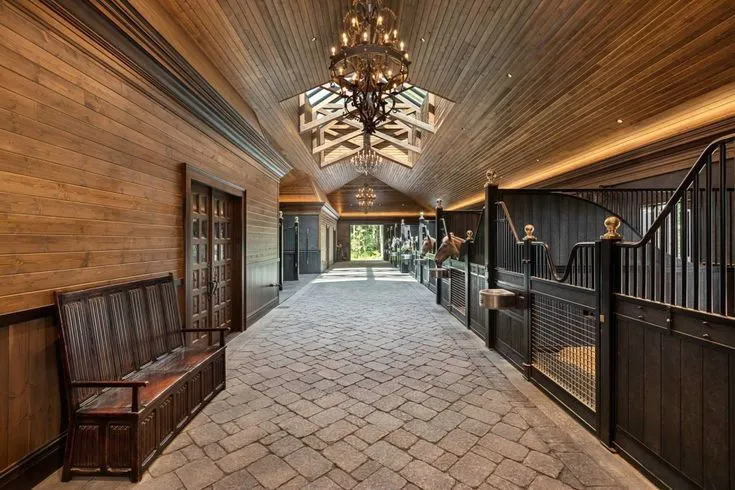
Photo: luxury private horse stable interior elegant barn architecture, via i.pinimg.com
For most of American architectural history, the stable was an apology — a handsome afterthought tucked behind the hedgerow, close enough for convenience, far enough to be forgotten. That era has ended. Walk the grounds of the most ambitious estates rising today in Wellington, Florida, or the rolling bluegrass of Lexington, Kentucky, and you will find equestrian facilities designed with the same rigor, the same materials budget, and frankly the same ego as the main residence.
The numbers tell the story quietly but unmistakably. Brokers in Wellington report that a property with a genuinely world-class barn complex — think 20 stalls, an indoor arena with engineered footing, and staff accommodations — can command a premium approaching eight figures over an otherwise comparable estate without one. In Aspen and the Roaring Fork Valley, where land is scarce and horses are a lifestyle signature, a finished equestrian compound is often the deciding variable in a bidding war, not the square footage of the main house.
Architecture Worthy of the Occupants
What distinguishes this generation of stable design is that architects are no longer treating the barn as a vernacular exercise. Firms known for coastal contemporary residences are bringing the same vocabulary — exposed timber structures, full-height glazing, standing-seam metal roofs, radiant-heated floors — to structures built for horses. The results are buildings that photograph like modern museums and function like precision instruments.
Interior aisles have widened from the traditional twelve feet to sixteen or more, allowing veterinary and farrier work to happen without congestion. Clerestory windows deliver natural light deep into stall rows, a detail borrowed from European sport facilities and now standard at the top of the American market. Stall fronts are fabricated from powder-coated steel and marine-grade hardwood, with hardware sourced from the same suppliers who outfit superyachts — a crossover that has become so common that several marine outfitting houses now maintain dedicated equestrian divisions.
The Yacht Outfitters Have Arrived
That last point deserves emphasis, because it reveals how the luxury economy is consolidating around these projects. The bespoke tack room of 2025 is a climate-sealed room of quarter-sawn oak cabinetry, brass fittings, humidity control, and integrated inventory systems — designed, in several documented cases, by the same craftsmen who build wine cellars aboard 90-meter yachts. Saddles are displayed under conservation lighting. Bridle collections are catalogued like art.
The logic is straightforward: the client who commissions a $40 million estate expects the same standard of finish everywhere on the property. A plywood saddle rack is no more acceptable in that world than a laminate countertop in the kitchen.
Climate, Footing, and the Science of Comfort
Beneath the aesthetics lies a genuine engineering discipline. High-specification facilities now routinely include:
- Climate-controlled barns with automated ventilation that maintains stable temperature and humidity year-round, critical in Florida's heat and Colorado's freeze-thaw cycles
- All-weather indoor arenas with laser-graded footing blends — silica sand, fiber, and wax coatings — engineered to reduce injury and drain instantly
- Hydrotherapy and veterinary suites with stocks, digital imaging, and rehabilitation treadmills on site
- Automated watering, feeding, and monitoring systems that let owners review each horse's intake and activity from a phone in another time zone
In Lexington, where thoroughbred heritage runs deep, buyers expect paddock layouts that honor the tradition of horse-friendly sightlines and shaded shelters. In Wellington, where the winter circuit draws an international equestrian set, proximity to show grounds is the multiplier — a five-minute trailer ride can double a property's competitive value.
The Premium Is Real, and It Is Quiet
Unlike a wine cellar or a home theater, an equestrian facility cannot be faked or retrofitted cheaply. The land requirement alone — usable acreage, drainage, trail or arena space — makes it a permanent feature of a property's identity. Appraisers have taken note: in established equestrian markets, a turnkey facility is now underwritten as an income-capable asset, since well-run barns can offset carrying costs through board and training revenue.
But most buyers in this tier are not calculating return on investment in dollars. They are calculating it in lifestyle. The client who flies in for a long weekend wants to ride at dawn on perfect footing, hand the horse to a professional at ten, and be at lunch in Aspen by noon. The estate that enables that rhythm — seamlessly, beautifully, without a single visible compromise — is the one that clears the market.
The stable, once hidden behind the hedgerow, now sits proudly at the head of the drive. In America's most discerning equestrian markets, it has earned its place there.