Still Waters, Deep Investment: How Private Lakes Became the Defining Feature of America's Modern Estates
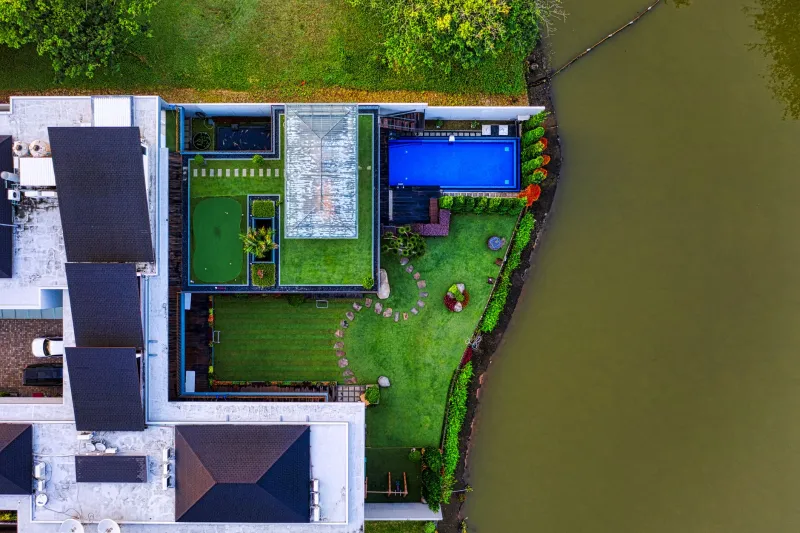
There was a time when the measure of an American estate was its acreage, its golf course, or the length of its motor court. Today, the question posed by the most discerning buyers is considerably more elemental: where is the water?
Across the country — from the horse country of Virginia to the foothills outside Aspen, from Texas ranchland to the lake-strewn wilds of northern Wisconsin — the new generation of ultra-luxury estates is being designed not merely to include water, but to be organized around it. Private lakes, commissioned waterfalls, and even moat-inspired waterways have become the centerpiece of a design philosophy in which the landscape is treated as a commissioned artwork in its own right.
The Commissioned Lake
A private lake is no longer the accidental byproduct of a low-lying pasture. It is engineered — dammed, lined, contoured, and stocked — to a specification as rigorous as any residence that rises beside it. Specialized aquatic design firms now work alongside estate architects from the earliest planning stages, shaping the lakebed in layers to support fish habitats, calibrating depth zones for swimming and boating, and selecting native plantings that keep the ecosystem in balance without chemical intervention.
Spring-fed lakes command particular reverence. Fed by a natural aquifer, they maintain clarity and temperature with minimal mechanical help, which is precisely what makes them the crown jewel of any water feature. In markets like Montana and Idaho, properties with verified spring-fed lakes routinely command premiums measured in millions of dollars over comparable acreage without one.
The costs are commensurate with the ambition. A fully commissioned recreational lake — complete with dam engineering, spillway design, shoreline architecture, and stocking programs — can run well into seven figures before a single stone of the main residence is laid.
Water as Architecture
Where the lake offers breadth, the architectural waterfall offers drama. These are not garden-variety koi pond cascades. The most ambitious examples channel thousands of gallons per minute over hand-set stone, engineered to be both heard and felt from the principal rooms of the residence. Designers speak of water the way they once spoke of light: as a material to be composed, directed, and made to perform.
Moats, once dismissed as historical affectation, have reappeared in softened form — reflecting pools and water bands that encircle a residence or garden pavilion, providing privacy, cooling, and a ceremonial approach worthy of the grand houses of Europe. The effect is less medieval fortress than modern sanctuary: a threshold that signals arrival in the most deliberate way possible.
Stewardship as Status
What distinguishes today's water commissions from the vanity projects of earlier eras is the emphasis on stewardship. Ultra-high-net-worth buyers increasingly expect their estates to function as functioning ecosystems, not ornamental ones. Wildlife corridors, migratory bird support, and catch-and-release fisheries are now standard line items in the estate program.
In regions such as the Carolinas and the Ozarks, conservation easements tied to lakefront acreage have become a sophisticated component of estate planning, marrying ecological responsibility with meaningful tax strategy. The water, in other words, must give back — to the land, to the wildlife, and to the generations who will inherit it.
The Symbolism of Permanence
Why water, and why now? Part of the answer is experiential: nothing anchors a landscape like a body of water, which changes with every hour of light and every season. But part of the answer is symbolic, and the most sophisticated buyers understand this instinctively.
Water is the oldest visual metaphor for permanence and power. A stone residence can be admired; a lake must be inherited. There is a reason the great houses of Europe — from Chantilly to Blenheim — were built around commissioned water. The American estates now following suit are not imitating history so much as rejoining it.
For buyers evaluating their next — and often final — estate, the message from the market is clear. The finest properties are no longer defined solely by what has been built upon the land, but by what has been coaxed from it. And increasingly, that begins with water: designed, engineered, and commissioned to outlast everyone who commissioned it.