The Art of the Table: How America's Finest Estates Are Designing Dining Rooms for Conversation, Not Performance
For much of the twentieth century, the formal dining room of a great American estate functioned as a kind of stage set — a room designed to be seen, admired, and remembered long after the meal itself had faded from memory. Ceilings soared. Crystal cascaded. Silver gleamed against surfaces chosen more for their reflective properties than for the warmth they might lend to a winter evening's gathering. The room, in short, was the point.
That era, for the most discerning segment of today's luxury market, appears to be drawing quietly to a close.
Across estates from the Hudson Valley to the hills above Santa Barbara, a new sensibility is taking hold among architects and interior designers working at the highest levels of residential commission. The formal dining room is being reconceived — not diminished, but fundamentally reoriented — around the idea that its truest measure of success is the quality of conversation it inspires rather than the impression it leaves on a guest's first glance through the doorway.
Grandeur Reconsidered
The shift is not a retreat from luxury. It is, if anything, a more demanding expression of it.
"Anyone can spend their way to a room that stops people in their tracks," notes one New York-based architect who has designed dining spaces for several prominent private estates along the Eastern Seaboard. "The far more difficult achievement is a room that draws people inward — that makes them lean toward one another, lower their voices slightly, and stay at the table long after the last course has been cleared."
This distinction — between a room that commands attention and one that rewards presence — is driving some of the most considered spatial decisions in contemporary estate design. Scale is being modulated with greater care. Proportions that once defaulted to the monumental are now calibrated to the human. A dining room intended for twelve may be designed to feel, at its most intimate, as though it holds only the six people gathered at its center.
Achieving this effect demands a sophisticated understanding of how architecture shapes behavior. Ceiling heights are chosen not merely for visual drama but for their acoustic consequences. A room that is too tall scatters sound and encourages voices to carry rather than to collect. A room of more considered height — still generous, still refined, but scaled to the conversation rather than the occasion — keeps dialogue close and unhurried.
The Discipline of Light
Perhaps no single design element does more to shape the tenor of a dining experience than light, and it is here that the most nuanced thinking is being applied.
The era of the grand chandelier as the dining room's unchallenged sovereign is giving way to something more layered and, ultimately, more sophisticated. Lighting designers working with elite residential clients increasingly speak of creating a hierarchy of illumination — one in which the table itself becomes the luminous center of the room while the surrounding architecture recedes into a considered warmth.
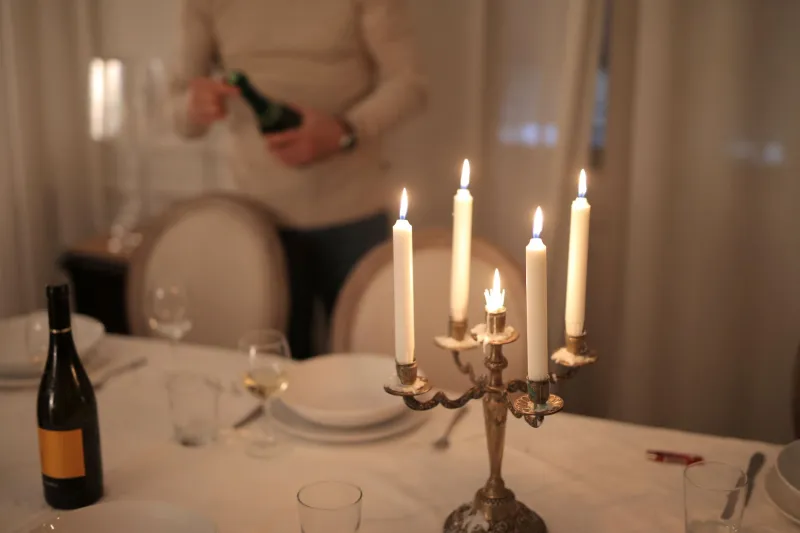
This approach draws on principles that predate electricity entirely. The candlelit tables of the eighteenth century — around which so much of Western intellectual and political life was conducted — worked precisely because they concentrated light at the human level, leaving the periphery in shadow. Faces were visible; the room was not. The effect was one of enforced intimacy, of a world temporarily reduced to the circle of people gathered around the flame.
Contemporary estate designers are revisiting this logic with modern precision. Dimmable systems calibrated to shift gradually over the course of an evening — brighter during the first course, warmer and lower as the meal progresses — are becoming a standard feature of the most thoughtfully executed dining spaces. Sconces placed at eye level supplement overhead sources without competing with them. Candlelight, whether from actual tapers or from fixtures that replicate its quality, is reintegrated not as an affectation but as a functional design decision.
"The goal," as one California-based lighting designer describes it, "is for guests to feel, by the time they've been at the table for an hour, that the room has grown smaller and warmer around them. That sensation — of the world contracting to the people you're with — is what makes a dining room truly work."
Materiality in Service of Warmth
Beyond light, the material choices that define a dining room's character are being reconsidered through the same lens of human comfort.
The hard, reflective surfaces that once signaled luxury — expanses of polished marble, lacquered walls, mirrored panels — are being balanced, and in some cases supplanted, by materials chosen for their acoustic and tactile properties. Upholstered wall panels, once considered the province of the traditional English country house, are reappearing in contemporary estate dining rooms, valued as much for their ability to absorb sound as for their visual softness. Natural textiles — linen, wool, aged leather — are favored over their synthetic counterparts, lending a quality of lived-in ease that no manufactured material can fully replicate.
Wood, in particular, is experiencing a quiet renaissance in the dining spaces of America's finest estates. Whether expressed in paneling, in flooring, or in the table itself — increasingly the room's single most considered object — timber introduces an organic warmth that stone and metal cannot provide. Furniture makers working at the intersection of craftsmanship and artistry are producing dining tables that function as the room's emotional anchor: surfaces worn by use, polished by care, and possessed of a presence that invites touch as much as admiration.
The Table as the Architecture
Indeed, the dining table has emerged, in the most considered estate interiors, as an architectural element in its own right — one around which the room is organized rather than merely furnished.
This represents a meaningful departure from the traditional hierarchy in which the room precedes and frames the furniture within it. When the table is understood as the room's raison d'être, decisions about proportion, orientation, and even the placement of windows and doorways flow outward from it. The table's dimensions determine the room's ideal width. Its position relative to a fireplace or a garden view shapes the room's entire spatial logic.
The most accomplished dining rooms being completed today on American estates feel, as a result, less like spaces in which a table happens to be placed and more like environments that have grown organically around the act of gathering. The distinction is subtle but unmistakable — and it is precisely the kind of distinction that separates a room one admires from a room one loves.
An Enduring Standard
The turn toward conversation-centered dining design reflects something broader about the values of today's most thoughtful estate buyers. For a generation that has witnessed the excesses of conspicuous display and found them wanting, the truest expression of refined living lies not in what a space announces but in what it enables.
A dining room that makes its guests feel seen, comfortable, and genuinely present in one another's company is, by this measure, among the most valuable spaces an estate can contain. It is a room that earns its place not through grandeur alone but through the quality of the evenings it makes possible — evenings that, long after the candles have been extinguished and the guests have departed, linger in memory as something more than a meal.