Illuminated Inheritance: How America's Great Families Are Commissioning Chandeliers as Enduring Legacies
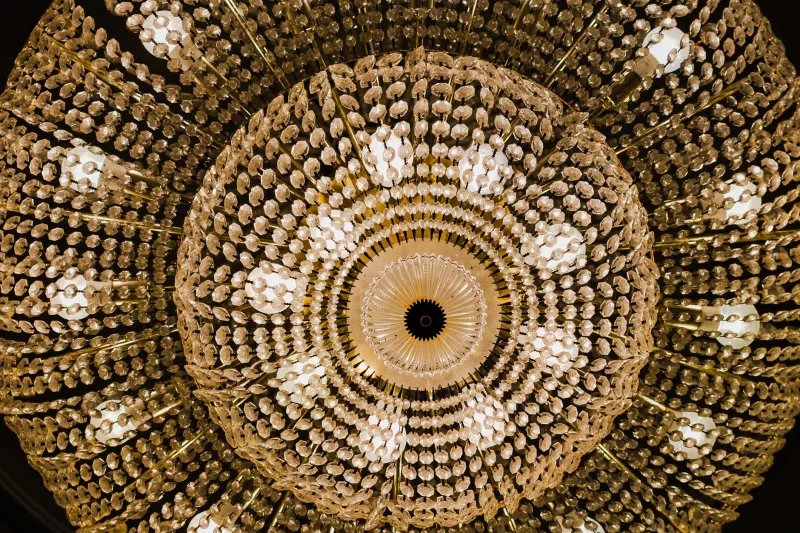
There is a particular kind of ambition that animates the most consequential decisions made within America's finest estates — not the ambition of the moment, but the ambition of the century. It is the ambition that commissions a library meant to house four generations of collected thought, or a wine cellar calibrated to peak at a vintage no one alive will drink. Increasingly, that same long-horizon thinking is being applied to a fixture that has, for centuries, governed the emotional life of the grand interior: the chandelier.
Among the country's most discerning families, the bespoke chandelier is no longer evaluated solely on aesthetic merit. It is being assessed as one might assess a significant work of art — for its provenance, its authorship, its material integrity, and its capacity to appreciate in value across market cycles that neither its commissioner nor its inheritors can fully anticipate.
The Chandelier as Balance Sheet Entry
The notion of a lighting fixture as a financial asset may initially seem unconventional. Yet estate advisors who specialize in tangible wealth — those who routinely counsel families on the stewardship of portfolios that include Old Master paintings, rare manuscripts, and museum-quality sculpture — report a notable shift in how their clients regard significant lighting commissions.
"We are seeing chandelier commissions appear in estate inventories alongside pieces from major auction houses," notes one New York-based wealth advisor who works exclusively with multi-generational family offices. "When a single fixture represents a six-figure or seven-figure investment in hand-worked bronze, antique crystal, and the labor of master artisans whose techniques trace back centuries, it demands the same documentation, insurance, and conservation planning as any other significant asset."
The analogy to fine art is not merely rhetorical. Like a significant painting, a bespoke chandelier carries within it the embedded value of irreplaceable human skill. Unlike mass-produced lighting — which depreciates the moment it leaves the showroom — a fixture conceived by a recognized atelier, fabricated from materials of documented provenance, and installed within a historically significant estate can appreciate meaningfully over decades. Auction records for antique chandeliers of distinguished origin routinely confirm this trajectory.
The Commission as Collaboration
For families who have arrived at this philosophy, the commissioning process itself becomes a form of creative legacy-making. The most ambitious projects begin not with a design brief, but with a conversation about narrative.
Master glassblowers and metalwork ateliers in the American Northeast and Mid-Atlantic — as well as their counterparts in Murano, Vienna, and London, whose work finds its way into American estates with considerable frequency — describe a new category of client: one who arrives with a family history rather than a mood board.
"The clients who commission work meant to endure are asking entirely different questions," explains a third-generation chandelier maker whose Philadelphia workshop has produced bespoke fixtures for some of the country's most celebrated private residences. "They are not asking what is fashionable. They are asking what will remain meaningful in fifty years. They want to know which materials age with dignity, which techniques will allow future restorers to work with the piece rather than against it, and how we document the process so that the story of the making is never lost."
This documentation impulse is significant. Families commissioning legacy fixtures increasingly request comprehensive archives: detailed technical drawings, material sourcing records, the names and biographies of contributing artisans, and photographic documentation of each stage of fabrication. These archives travel with the fixture across generations, functioning as both a conservation manual and a certificate of authenticity that protects and enhances the piece's value over time.
Restoration as Stewardship
The question of restoration is, for those who think in generational terms, as important as the question of creation. A chandelier designed with longevity in mind must be conceived with its own future repair in mind — a consideration that fundamentally shapes material selection and structural engineering.
"We refuse to use proprietary components that will become unavailable," says the director of a Boston-based conservation studio that specializes in historic lighting. "Every element we incorporate into a legacy commission must be replicable by a skilled craftsperson working fifty or one hundred years from now. That means traditional joinery, documented alloy compositions, and crystals cut to specifications we deposit with the client's estate archive."
Restoration, handled with this level of rigor, does not diminish provenance — it deepens it. A chandelier that has been thoughtfully conserved across three generations carries within its structure a layered history of human attention, each intervention a record of the family's ongoing commitment to the object's integrity. In this respect, the restored chandelier behaves much as a well-maintained historic estate does: its age, far from being a liability, becomes its most compelling credential.
The Estate as Total Composition
For the families who have embraced this philosophy most fully, the legacy chandelier does not exist in isolation. It functions as the luminous center of a larger compositional strategy — one in which every significant element of the estate, from its architectural bones to its horticultural design, is conceived with the same intergenerational ambition.
Estate architects working at this level describe the chandelier as the "emotional axis" of a grand interior — the element around which the spatial experience of the home is organized, and toward which the eye is inevitably drawn upon entering. When that fixture is also a work of singular artistic achievement, the psychological effect compounds: the home becomes not merely a residence, but a collection, and the chandelier its most visible and emotionally resonant piece.
"There is a reason that the great houses of American history — the Newport cottages, the Hudson Valley estates, the grand Chicago mansions — are remembered in part by their chandeliers," observes one architectural historian who consults on the restoration of Gilded Age properties. "These fixtures were never incidental. They were statements of intention, of permanence, of the family's belief in its own continuity. The families commissioning legacy pieces today understand that tradition perfectly."
A New Standard of Permanence
In an era when interior design trends cycle with accelerating speed, the deliberate commissioning of an object designed to resist obsolescence is itself a form of cultural statement. It signals a refusal to participate in the disposability that characterizes so much of contemporary material culture — a conviction that beauty, properly made and properly maintained, is not subject to the same entropy as fashion.
For the estates that bear these fixtures, and for the families who will inherit them, the chandelier becomes something more than a source of light. It becomes a point of continuity in a world that offers very few. It is the thing that was there at the dinner before a child was born, and at the dinner when that child celebrated their own marriage, and at the dinner, decades hence, when grandchildren gather beneath its light to mark another passage in the family's unfolding story.
At Château Chandler, we believe that the most enduring estates are not those built to impress a single generation, but those conceived to shelter and inspire many. The legacy chandelier — designed with care, documented with rigor, and restored with devotion — is among the most eloquent expressions of that belief.