Flame Over Circuit: Why America's Most Discerning Estates Are Reclaiming the Art of Hand-Lit Living
There is a particular kind of silence that descends when the last smart panel goes dark and the first taper is lit. It is not the silence of absence. It is the silence of intention—of a room asserting, with quiet authority, that some experiences cannot be optimized.
Across America's most thoughtfully appointed estates, a countermovement is gathering momentum. The very homeowners who once commissioned elaborate home automation systems—voice-activated lighting grids, circadian rhythm programming, app-controlled ambiance—are now requesting something their architects have rarely been asked to design: rooms that deliberately resist automation entirely. Spaces governed by wax, wick, and the unhurried hand of a person who chooses, each evening, to be present.
This is not nostalgia. This is a considered philosophical stance, and it is reshaping how the most discerning buyers in the country define luxury itself.
The Automation Paradox
For the better part of two decades, comprehensive home automation was considered the definitive marker of a truly premium estate. Lighting systems that anticipated your mood before you could articulate it, sensors that adjusted color temperature as the sun moved across the sky, voice commands that summoned precisely calibrated ambiance at a word—these were the hallmarks of a home at the frontier of refined living.
And yet, something unexpected has occurred. The very seamlessness that made these systems so appealing has, for a growing cohort of ultra-high-net-worth homeowners, become its own form of impoverishment. When every atmospheric decision is made on your behalf, the argument goes, you cease to inhabit your home in any meaningful sense. You become, in the most elegant possible way, a passenger.
"There is a certain class of client who has arrived at the conclusion that total automation is, paradoxically, a surrender of agency," observes one interior architect whose portfolio spans estates from the Hudson Valley to coastal California. "They have every convenience imaginable, and they have begun to find it quietly deadening."
Rooms Designed for the Unmediated Moment
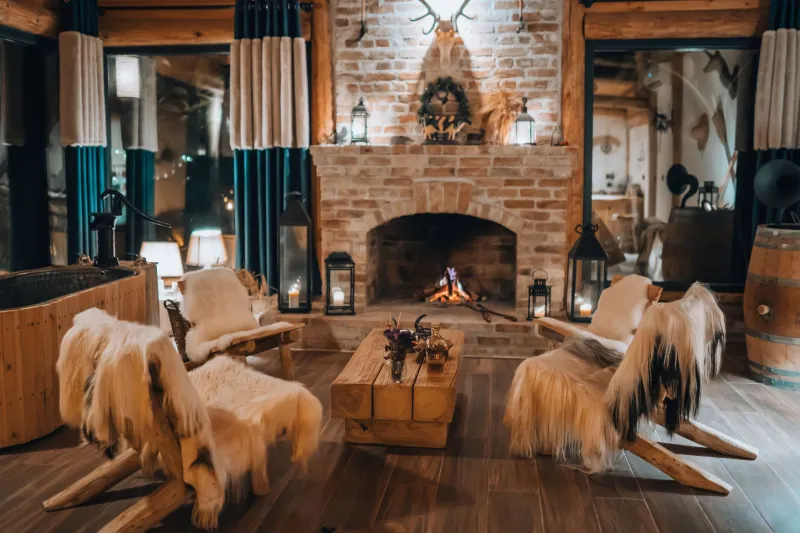
The architectural response to this sentiment has been both pragmatic and poetic. Designers are now creating dedicated chambers within larger estates—sometimes called candlelit salons, sometimes simply referred to as "the quiet room"—that are wired for minimal electrical infrastructure by deliberate choice. These spaces forgo recessed lighting, automated dimmers, and smart controls in favor of sconce mounts sized for tapers, deep-set niches built for pillar candles, and fireplace surrounds engineered to serve as the room's primary light source.
The effect is profound and immediate. Guests who step into these rooms report a perceptible shift in their own behavior—voices soften, posture changes, conversation deepens. The flicker of an open flame introduces a quality of movement and warmth that no LED, however sophisticated, has yet convincingly replicated. Shadows behave differently. Faces appear differently. The room, in a very real sense, performs differently.
One estate in the Virginia countryside recently completed a dedicated evening salon positioned adjacent to its principal library. The room was designed without a single automated fixture. Its sole illumination sources are a pair of hand-forged iron chandeliers fitted for tapered candles, a working hearth faced in reclaimed limestone, and a series of wall-mounted hurricane lanterns. The homeowners have described it, without irony, as the most-used room in a twelve-thousand-square-foot residence.
The Tactile as the New Exclusive
What makes this movement particularly resonant within the luxury market is the way it reframes the concept of exclusivity itself. For years, exclusivity was largely synonymous with access—access to technology not yet available to the broader market, access to materials sourced from the world's most remote quarries, access to craftspeople whose waiting lists stretched across years. These remain valid expressions of distinction. But they are expressions that, with sufficient resources, can be acquired.
The hand-lit room offers something different: an experience that cannot be automated, cannot be delegated to a system, and cannot be replicated by anyone who is not physically, attentively present. The act of moving through a space with a taper, lighting each candle in sequence, adjusting the flame of a lantern against a draft—these are gestures of intimate engagement with one's own home. They are, in the truest sense, irreducibly human. And in an age when nearly every domestic function can be outsourced to a network, that irreducibility has become extraordinarily rare.
Designers note that clients pursuing this aesthetic tend to be among the most intellectually engaged and culturally well-traveled. They are not rejecting technology because they distrust it. They are setting it aside, in specific rooms, at specific hours, because they understand precisely what is lost when it is always present.
The Craft Behind the Simplicity
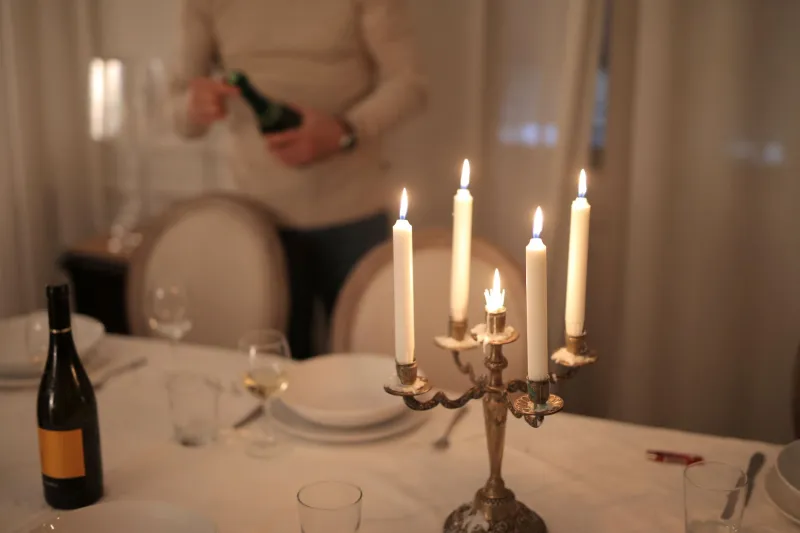
It would be a mistake to interpret the hand-lit aesthetic as a retreat from quality. In practice, the opposite is true. The estates embracing this philosophy invest with particular seriousness in the objects that populate these rooms. Candlesticks are commissioned from silversmiths with generations of experience. Beeswax tapers are sourced from small-batch American producers who still dip by hand. Lanterns are fabricated in custom metalwork studios whose artisans treat each piece as a sculptural object.
Fireplace surrounds receive similar attention. Where once a fireplace might have served a largely decorative function in a heavily automated interior, it now assumes a genuine primacy—and is designed accordingly. Mantels are carved with the care once reserved for museum-quality furniture. Hearths are proportioned for actual use rather than visual effect.
The result is a room that is, in material terms, among the most expensive in the estate—even as it appears, at first glance, to be among the most restrained.
What This Reveals About Luxury's Direction
The candlelit room is, at its core, a statement about time. It signals that the homeowner possesses something rarer than any automated system: the willingness to slow down, to perform a ritual, to inhabit an evening rather than merely pass through it. In a culture that has perfected the art of frictionless convenience, friction—chosen, curated, meaningful—has become its own form of extravagance.
For the estate buyer who has considered everything, who has specified every material and programmed every system, the question eventually becomes not what more can be added, but what might be deliberately, beautifully withheld. The answer, increasingly, is the light itself.
At Château Chandler, we observe these movements not merely as design trends but as reflections of how the most thoughtful homeowners understand their relationship to the spaces they inhabit. The hand-lit estate is not a step backward. It is, in every meaningful sense, a step deeper—into presence, into craft, and into the kind of living that no system, however sophisticated, can replicate.