Composing Silence: The Rise of Acoustical Architecture in America's Premier Estates
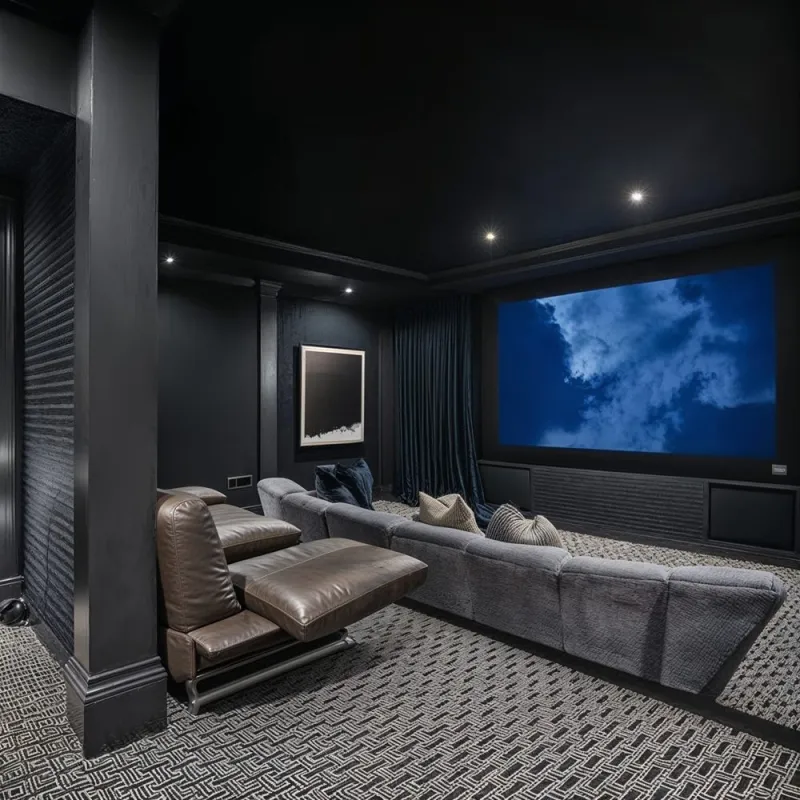
Photo: luxury home theater acoustical design interior dark elegant, via www.omnihomeideas.com
There is a moment, upon entering certain extraordinary homes, when the outside world simply ceases to exist. The ambient hum of a distant highway, the percussion of a neighbor's landscaping crew, the restless murmur of wind through ill-fitted windows—all of it vanishes. What remains is an almost sacred stillness, punctuated only by whatever sound the homeowner has chosen to introduce. This is not accident. It is architecture.
Across the country's most coveted residential markets—from the verdant hills of Bel Air to the horse country estates of Middleburg, Virginia—acoustical engineering has emerged as one of the defining disciplines of ultra-luxury home design. Where once it was relegated to recording studios and concert halls, sophisticated sound management has now become a primary concern for clients whose standards extend well beyond the visual.
Sound as a Design Material
The most forward-thinking estate designers now speak of sound as a material in its own right—as tangible and malleable as stone, steel, or glass. "When we begin a project at this level, we are not thinking about acoustics as a retrofit or an afterthought," explains one Los Angeles–based architect whose portfolio includes several nine-figure private residences. "We are thinking about the sonic character of every room from the very first sketch."
This philosophy manifests in ways both structural and subtle. At the structural level, it begins with mass: thick concrete cores, double-stud wall assemblies, and resilient channel systems that mechanically decouple interior surfaces from the building's primary frame. These techniques interrupt the pathways through which vibration travels, preventing sound from migrating between rooms or entering from the exterior. In practice, the result is a home that does not merely muffle noise—it absorbs it entirely.
Beyond structure, the geometry of a room carries enormous acoustic consequence. Parallel walls create standing waves that produce an unpleasant resonance; slight angles, carefully calculated, disperse sound energy in ways that feel natural and effortless to the ear. Ceiling heights, alcove depths, and the placement of openings all participate in what acoustical consultants refer to as the "room signature"—the characteristic way a space interacts with sound.
The Private Concert Hall Standard
Perhaps nowhere is the ambition of modern residential acoustics more apparent than in the dedicated home theater and private performance space. For clients who entertain at the highest levels—or simply demand an immersive private cinema experience—the benchmark is no longer the multiplex or the premium screening room. It is Carnegie Hall.
Achieving concert-hall-quality acoustics within a residential footprint requires an extraordinary degree of precision. Reverberation times must be engineered to suit the intended use: a room designed for orchestral music demands a longer, warmer decay than one optimized for cinematic dialogue and effects. The two are, in acoustic terms, nearly opposite environments, which is why many estates now commission entirely separate spaces for each purpose.
The materials employed in these rooms read like a study in contrasts: dense, sound-absorbing panels composed of compressed mineral wool sit alongside reflective hardwood surfaces and custom-fabricated diffusers that scatter sound energy without deadening it. Every element is tuned. Nothing is decorative in the conventional sense; even the upholstery on a custom theater seat is selected, in part, for its absorption coefficient.
Silence as Sanctuary: Wellness Spaces and the Acoustic Interior
Beyond entertainment, the demand for acoustical precision has extended into the wellness realm. Meditation rooms, yoga studios, and spa facilities within private estates increasingly require what designers call an "anechoic quality"—an environment so acoustically neutral that the occupant becomes acutely aware of their own breath. This is not merely a comfort amenity. For clients who use their homes as genuine retreats from the pressures of professional life, the capacity to achieve genuine quiet carries measurable therapeutic value.
Some estates have taken this principle further still, commissioning floating-floor construction in master bedroom suites to eliminate the transmission of low-frequency vibration from mechanical systems. Others have invested in active noise cancellation technology—systems that analyze incoming sound waves and generate precise counter-frequencies to neutralize them—a technology once associated exclusively with aviation headsets, now embedded invisibly within residential walls.
The Invisible Infrastructure
One of the most compelling aspects of contemporary residential acoustics is how completely it can be concealed. The finest work in this discipline leaves no visible trace: no foam panels, no industrial-looking hardware, no suggestion of the engineering complexity beneath the surface. Fabric-wrapped absorption panels are upholstered in the same materials as surrounding walls. Diffusers are integrated into millwork and coffered ceilings. Speaker systems—whether distributed audio or dedicated home theater arrays—are recessed, in-wall, or, in the most sophisticated installations, embedded within architectural surfaces that vibrate as transducers themselves.
This invisibility is, in many respects, the ultimate luxury. The homeowner experiences the benefit without encountering the mechanism. Sound behaves exactly as intended, in every room, at every hour—and the technology that makes it possible remains entirely out of sight.
A New Vocabulary for the Discerning Buyer
For buyers evaluating estates at the highest tier of the market, acoustical specification has begun to appear alongside lighting control, climate zoning, and home automation as a non-negotiable feature of a truly complete residence. Questions that would once have been asked only by recording professionals—What is the noise isolation rating of the primary bedroom? Has the theater been tuned by a certified acoustical consultant? Are mechanical systems on isolated vibration mounts?—are now standard due diligence for clients whose expectations have evolved accordingly.
The finest estates, in this sense, are increasingly understood as instruments. Like a well-crafted violin or a precisely voiced grand piano, they are designed not merely to look extraordinary, but to perform—to produce, within every room and across every experience, exactly the sound their owner intends. In a world of relentless noise, that degree of control is, without question, among the most refined luxuries available.