Hidden in Plain Sight: The Architecture of Deliberate Disappearance
For generations, the defining aspiration of the American estate was visibility. A sweeping drive, a commanding portico, a roofline that announced itself to anyone passing on the road below—these were the hallmarks of arrival, both literal and social. That era, for the most discerning tier of buyers, is quietly drawing to a close.
Today, the architects and landscape designers commissioned by America's most sophisticated homeowners are engaged in an entirely different pursuit: making vast, meticulously appointed properties all but disappear. The paradox at the heart of this movement is elegant and deliberate. The estate is extraordinary. The experience of it—from the road, from the air, from a neighboring parcel—is nearly nothing at all.
This is not modesty. It is mastery.
The Cultural Shift Driving Concealment
To understand why discretion has become the ultimate design currency, one must first appreciate the broader cultural context shaping ultra-high-net-worth living in the United States. In an era of heightened public scrutiny, social media saturation, and an intensifying national conversation around wealth disparity, conspicuous display carries a different charge than it once did. The buyers commissioning these concealed compounds are not retreating from luxury—they are redefining what luxury means in practice.
Privacy, once a feature of an estate, has become its organizing principle. Security consultants now sit alongside architects at the earliest design meetings, and their influence extends far beyond gate systems and surveillance technology. The most effective security, as the industry increasingly recognizes, is the kind that removes a property from perception entirely.
This philosophy has a name among a growing cohort of designers: architectural camouflage. And its practitioners are among the most sought-after professionals in the luxury residential market.
The Techniques of Disappearance
Architectural camouflage is not a single technique but a layered discipline, requiring coordination across site selection, structural design, material specification, and landscape strategy.
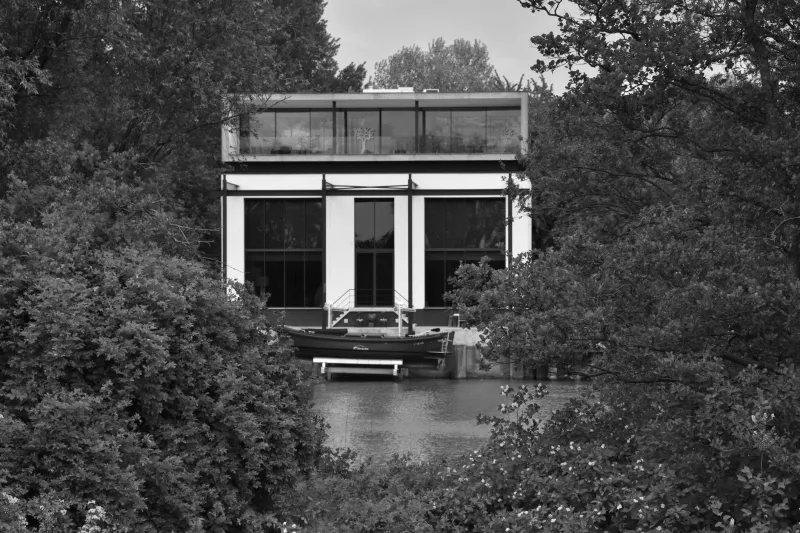
Strategic land positioning is typically the first intervention. Rather than siting a residence at the crown of a hill—the traditional choice for maximizing views and commanding presence—contemporary concealment-focused estates are often nestled into topographical folds, tucked behind natural ridgelines, or positioned within existing tree canopies that pre-date construction. In states such as Colorado, Montana, and the Pacific Northwest, where dramatic terrain offers abundant natural cover, this approach can render a ten-thousand-square-foot home functionally invisible from any public vantage point.
Material selection serves the same concealing function. Weathering steel, locally quarried stone, board-and-batten siding left to silver naturally, and rammed earth walls do not merely reference the surrounding landscape—over time, they become indistinguishable from it. Glass, used extensively in high-end residential design for its connection to nature, is here chosen not for transparency but for its reflective properties, mirroring sky and treeline back to any observer who might otherwise discern a structure within.
Living roofs and earth-sheltered construction represent perhaps the most dramatic expression of this philosophy. Estates in Vermont, the Hudson Valley, and along the California coast have employed sod and sedum roof systems that, viewed from above—including from drone or helicopter—present an unbroken plane of meadow or meadow-adjacent planting. The home beneath may contain a twelve-car garage, a climate-controlled wine cellar, and a full spa facility. From altitude, it registers as nothing more than a gentle rise in the ground.
Native plantings and ecological restoration complete the picture at ground level. Where earlier generations of estate landscaping favored manicured lawns, clipped hedgerows, and ornamental plantings that announced human intervention, today's concealment-focused properties are restored to something closer to their pre-development ecological state. Native grasses, regional wildflower meadows, and species-appropriate woodland understory do not merely screen the home—they actively reclaim the visual language of the site, making any structure behind them feel like an interruption of nature that the eye declines to pursue.
The Paradox of Experience
What makes these properties genuinely remarkable—and genuinely rare—is that the experience of concealment operates exclusively outward. Cross the threshold, and everything changes.
The same estate that presents a blank face of meadow grass and mature oak canopy to the road beyond reveals, from within, a sequence of spaces defined by extraordinary craftsmanship, light, and material richness. Floor-to-ceiling glazing that renders the exterior wall nearly invisible from outside floods interior rooms with landscape views of remarkable intimacy. The home does not ignore its setting; it consumes it. The owners live inside a panorama that the world outside cannot access or even verify.
This inversion—spectacular from within, invisible from without—is the precise quality that commands premium valuations among buyers who have moved beyond the traditional metrics of luxury real estate.
What the Market Reflects
For buyers and their advisors actively engaged in the upper tier of the American estate market, the implications are worth considering carefully. Properties that have achieved genuine concealment—through the disciplined application of the techniques described above—tend to attract a buyer profile that is both patient and exacting. These are not impulse acquisitions. They are the result of years of planning, substantial design investment, and a clear-eyed understanding of what privacy, at the highest level, actually requires.
The resale dynamics of such properties are equally distinctive. Because concealment is expensive to achieve and difficult to replicate, well-executed examples command significant premiums over comparably appointed estates that remain conventionally visible. Scarcity, in this context, is not a function of location or square footage alone—it is a function of design intention carried through to completion.
At Château Chandler, we regard these estates as among the most significant expressions of contemporary luxury residential design. They represent a convergence of architectural sophistication, landscape intelligence, and philosophical clarity about what it means to live extraordinarily—and entirely on one's own terms.
The finest homes, it turns out, are the ones the world never quite manages to find.