The Art of Invisible Boundaries: Landscape Design as Privacy on America's Finest Estates
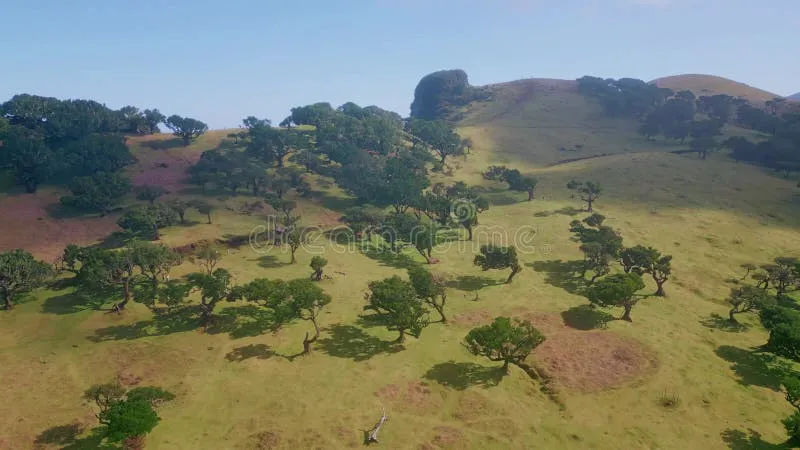
Photo: luxury estate private landscape design rolling hills native trees aerial view, via thumbs.dreamstime.com
For generations, the instinct of the wealthy landowner was to build inward — to erect walls, plant dense hedgerows, and draw the perimeter as a declaration of dominion. That impulse, while understandable, has begun to give way to something far more sophisticated. Across the Hudson Valley, the hills of Marin County, the horse country of Middleburg, Virginia, and the coastal bluffs of the Pacific Northwest, a new generation of estate owners is choosing a different approach entirely: the invisible boundary.
This is not the absence of privacy. On the contrary, it is privacy elevated to the level of landscape art — a discipline in which the land itself becomes the guardian, and the experience of seclusion is woven into every sight line, every footfall, and every seasonal shift on the property.
The Problem With Walls
The fortress aesthetic has always carried a certain cost. A high perimeter wall announces its own anxiety. It draws the eye of the passerby, communicates defensiveness rather than confidence, and, perhaps most critically for the discerning owner, severs the estate from its broader natural context. In a region of rolling meadows or ancient hardwood forest, a masonry wall is not merely an eyesore — it is an architectural contradiction.
Leading landscape architects working at the highest levels of the American estate market have long recognized this tension. The goal, as one principal at a prominent Napa Valley firm described it, is to make a guest feel as though the privacy of the property is simply the nature of the place — as though the land itself has chosen to remain undisturbed.
Achieving that sensation requires a command of multiple disciplines simultaneously: horticultural science, civil engineering, hydrology, and spatial psychology. It is, by any measure, among the most demanding forms of design practiced today.
Topography as the First Line of Defense
Before a single plant is selected or a water feature conceived, the most effective tool available to the landscape designer is the land's own contour. Strategic grading — the deliberate reshaping of terrain — can render an estate visually inaccessible from a public road without the introduction of any vertical element whatsoever.
A gently depressed motor court, a berm that rises almost imperceptibly as it approaches the property line, a hillside reshaped to direct the eye toward the sky rather than toward the residence: these interventions are invisible in their subtlety and absolute in their effect. On flat sites, where topographical manipulation requires more significant earthwork, the investment is considerable, but the outcome — a property that appears to recede naturally into its surroundings — is often irreplaceable.
Some of the most celebrated estates in the American West have employed this technique to dramatic effect, shaping the land so that the main residence becomes visible only upon arrival, revealed gradually through a choreographed sequence of approach rather than announced from the road.
The Living Screen: Native Plantings and Woodland Buffers
Once the ground plane is addressed, the vertical layer becomes the designer's canvas. Here, the choice between ornamental and native plantings carries consequences that extend well beyond aesthetics. Native species — whether the Eastern white pine of New England, the live oak of the Southeast, or the Western red cedar of the Pacific coast — possess a particular quality that their ornamental counterparts cannot replicate: they belong.
A buffer of indigenous woodland reads not as a planted screen but as an extension of the regional landscape, lending the estate an air of permanence and ecological authenticity that is increasingly prized by buyers at the highest market tier. These plantings also require less intervention over time, maturing into their roles as natural dividers without the maintenance burden of clipped formal hedges.
For estates where a more immediate screening effect is required, layered planting strategies — combining canopy trees, understory species, and ground-level shrubs in staggered densities — create visual barriers that are both effective and entirely naturalistic in their appearance.
Water as Boundary and Spectacle
Perhaps no element in the landscape designer's toolkit is more versatile — or more psychologically powerful — than water. A properly positioned stream, pond, or constructed wetland performs multiple functions simultaneously: it establishes a natural edge that discourages casual approach, it introduces ambient sound that masks exterior noise, and it creates a sensory threshold that signals, without any explicit communication, that one is entering a distinct and private world.
On larger estates, the deliberate manipulation of drainage patterns can create wetland margins or meadow channels that function as elegant, ecologically productive boundaries. On more compact properties, a reflecting pool positioned at the edge of a terrace can define the estate's limits while enhancing the architectural composition of the main residence.
The most accomplished landscape architects treat water not merely as an amenity but as a structural element — one that shapes movement through the property, controls views, and contributes to the estate's overall acoustic environment.
The Psychology of Arrival
Ultimately, the invisible boundary is as much a psychological construction as a physical one. The most private estates in America achieve their seclusion not through any single technique but through the cumulative effect of a carefully choreographed arrival sequence — a journey from the public realm to the private one that is managed at every stage through design.
The transition begins at the property entrance, where the drive may curve gently away from the road, passing through a canopy of mature trees before opening onto a composed view of the residence. It continues through the motor court, where planting and grade conspire to create a sense of enclosure without confinement. It culminates at the threshold of the home itself, where the owner stands surrounded not by walls of stone or iron but by a landscape that has quietly, elegantly, and entirely kept the world at bay.
For those who seek not merely a residence but a true retreat, this is the standard to which the most distinguished estates in America now aspire.